
Construction companies rarely fail because of one big mistake. More often, profitability erodes slowly due to blind spots that stay hidden until cash flow tightens, jobs slip off schedule, or growth exposes weaknesses the business wasn’t ready to absorb.
What surprises business owners most is that these blind spots often have very little to do with tax compliance. They’re operational, financial and strategic issues that show up inside real construction companies every day.
According to Adam Wuerfele, Senior Manager at SSC CPAs + Advisors, many construction owners are focused on running projects and serving clients, not analyzing financial statements.
Most of these business owners didn’t start the business because they like the accounting side of things. They started because they were passionate about the work itself. But to keep doing that work successfully, they need to have their financial house in order.”
At SSC, we help construction leaders build financial agility, enabling them to spot problems earlier, make better decisions and grow in ways that strengthen long-term business value. SSC serves a wide range of construction businesses, from closely-held companies and family-owned firms to ESOP-owned organizations, and understands the unique challenges that come with managing growth in the industry.
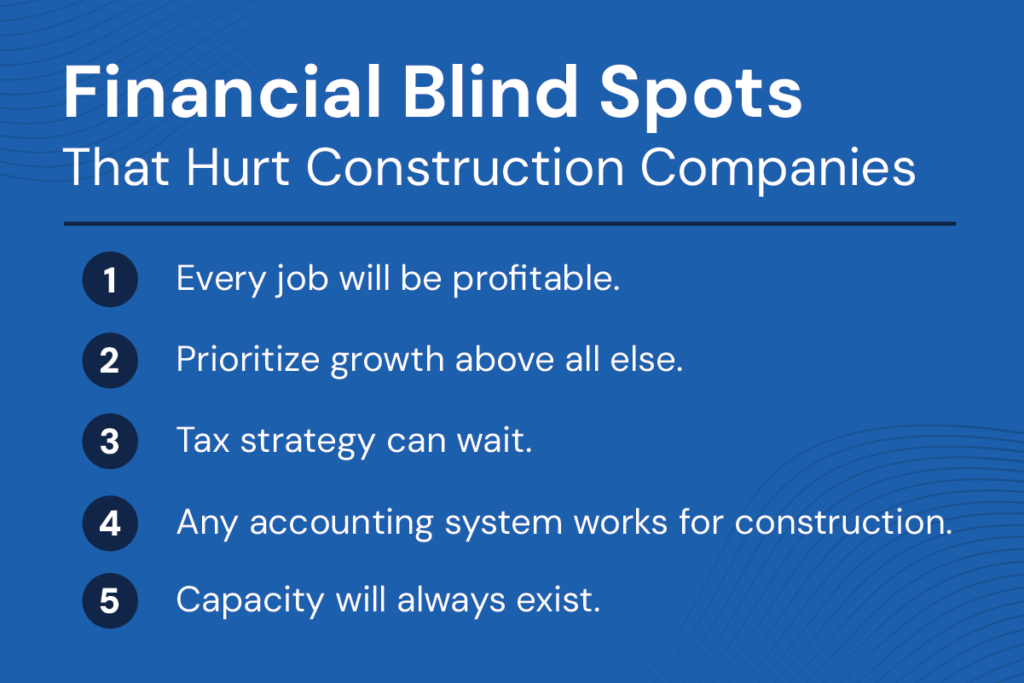
Many construction owners assume every project will work itself out, even when early indicators suggest otherwise. It’s easy to believe a slow start can be corrected later or that overruns will balance out by the end of the job. Unfortunately, that mindset creates a dangerous blind spot.
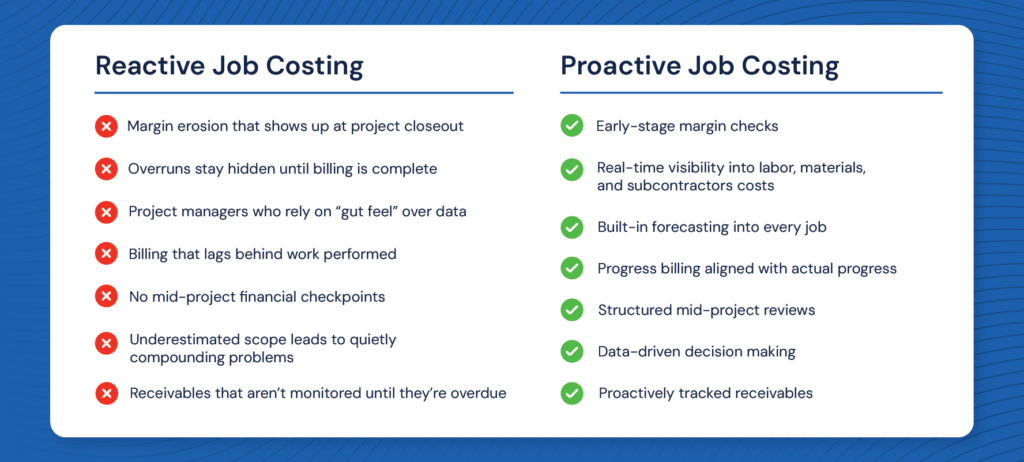
When companies rely on optimism instead of data, they miss early signs that margins are slipping. Job costing becomes reactive instead of proactive. By the time final numbers come in, the damage is often already done.
Wuerfele sees this happen regularly. “Sometimes those jobs are not going to be the moneymaker they thought they were going to be.”
He points out that profitability issues can stem from inaccurate bidding, scope misunderstandings, labor challenges, project management breakdowns, or factors completely outside a contractor’s control such as material delays. The key isn’t avoiding every problem. It’s identifying problems early enough to respond effectively.
Why this blind spot hurts:
Healthy companies treat job costing as a real time decision tool instead of a post project report. Strong financial managers track performance early and often, giving leaders visibility into whether a job is truly profitable or drifting off plan.
Construction growth feels exciting. Bigger jobs, bigger revenue and bigger opportunities sound great at first, but growth without structure creates chaos.
Many companies chase top-line revenue (“We want to be a $10M company”) without realizing they’re keeping less profit than they did at $5M. The business expands, but the systems, leadership and working capital don’t.
Wuerfele frequently sees construction companies compare themselves to larger competitors and assume they’re ready for the next level before they have the necessary infrastructure in place.
“They don’t have the labor in place. They don’t have the accounting system in place. They don’t have the right infrastructure in place to be able to handle those projects.”
This is one of the most expensive blind spots in the industry.
Why this blind spot hurts:
Growth isn’t success if it destabilizes the business. Healthy companies grow on a timeline that matches their capacity, not their ambition. They invest in project managers, systems, and cash flow before they chase larger bids.
This is where SSC’s advisory approach stands out. We help owners understand whether their asset allocation, staffing and financial structure can actually support the growth they’re pursuing.
Construction companies often buy equipment, expand operations, hire teams and make other major decisions without looping in a tax advisor early enough.
Tax strategy should be part of every major decision, not something revisited at year-end. When companies wait too long, they miss opportunities to strengthen cash flow and align their financial structure with long-term goals.
Wuerfele often encounters business owners whose primary goal is simply avoiding taxes. He encourages owners to think differently about profitability and taxation. “The goal is not simply to eliminate every dollar of tax. In many cases, income tax is a byproduct of having a profitable business. The better question is whether the company has planned appropriately and is taking advantage of the available strategies that support its long-term goals.”
But if you wait too long to develop a tax strategy? It could impact you and your business tremendously.
Why this blind spot hurts:
Healthy companies treat tax planning as an ongoing conversation — the kind a CFO might initiate — even if they don’t have one on staff. SSC helps construction leaders understand how tax strategy supports growth, not just compliance.
Construction companies often use accounting systems that weren’t built for construction.
General-purpose accounting platforms can work well for basic bookkeeping and may be sufficient for some smaller contractors. As a construction company grows, however, those systems may not provide the depth of job costing, progress billing, labor tracking, and multi-project forecasting management needs without significant add-ons or manual workarounds.
SSC has seen companies try to patch together workarounds. We witnessed others invest in expensive systems that don’t fit their operations. Either way, bad information leads to bad decisions.
Why this blind spot hurts:
Healthy companies invest in tools that match their operational reality. They treat financial systems as strategic assets and rely on advisors who can help them evaluate whether their systems support growth or hold it back.
Construction backlogs are strong right now, but opportunity isn’t the same as capacity. Many companies take on work they aren’t ready to execute. Demand isn’t lacking; what’s missing is:
This blind spot becomes especially dangerous during boom cycles, when companies feel pressure to say “yes” to everything.
As Wuerfele puts it: “It’s not a matter of if something will blow up. It’s a matter of when.”
Healthy companies understand that capacity is carefully built rather than quickly cobbled together. They evaluate whether their people, processes and financial structure can support the work they’re taking on. They grow intentionally, not reactively.
This is where SSC’s advisory role becomes essential, as our expertise lies in helping owners understand whether their current structure can support the next phase of growth.
Construction companies don’t need perfect financial systems to succeed. They need the ability to identify problems early, understand what’s changing and make decisions that protect profitability and long term business value.
That’s what SSC helps financial managers, CFOs, Controllers and business owners build:
If you want help identifying blind spots inside your construction company, SSC is ready to serve as your extra set of eyes. Contact us today to arrange a free consultation.
“SSC CPAs + Advisors” and “SSC” are the brand names under which SSC Advisors, Inc. and SSC CPAs, PA provide professional services. SSC Advisors, Inc. and SSC CPAs, PA practice as an alternative practice structure in accordance with the AICPA Code of Professional Conduct and applicable law, regulations, and professional standards. SSC CPAs, PA is a licensed independent CPA firm that provides attest services to its clients, and SSC Advisors, Inc. entities provide tax, advisory, and business consulting services to their clients. SSC Advisors, Inc. is not a licensed CPA firm. Our use of the terms “our firm” and “we” and “us” and terms of similar import, denote the alternative practice structure conducted by SSC Advisors, Inc. and SSC CPAs, PA. Advisory services provided through Merit Financial Group, LLC. Merit Financial Group, LLC is a registered investment advisor with the U.S. Securities and Exchange Commission.