
When business leaders talk about “getting their financials done,” they often mean very different things. Some need a full audit to satisfy federal requirements. Others only need a review to provide limited assurance to a lender or board. And many organizations simply need their financial statements compiled in the correct format.
But here’s the real challenge: choosing the wrong level of service can cost you time, money, and credibility. On the other hand, choosing the right one can strengthen trust, improve decision making, and keep your organization moving forward.
This guide breaks down the differences between audits, reviews, and compilations so you can confidently make the right call.
Financial transparency isn’t just a series of compliance boxes to check. It’s a leadership responsibility.
Clear and robust financial reporting helps you:
If you’re asking yourself why your company might need a financial audit or how often you should review financial statements, you’re already thinking like a proactive leader.
Below is a clear, practical way to understand how audits, reviews, and compilations differ, without getting lost in technical jargon.
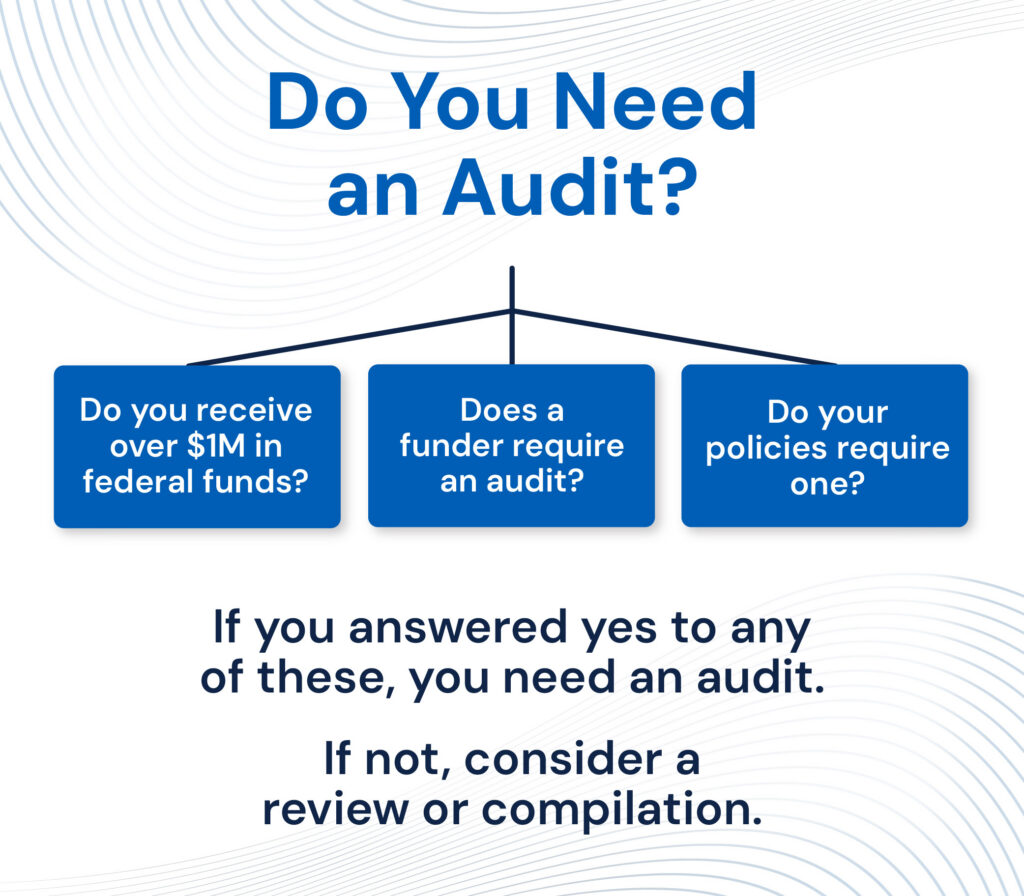
An audit provides the highest level of assurance that your financial statements are accurate and free from material misstatement. It includes testing, verification, and a deep dive into your financial processes.
You may need an audit if:
Audits answer key questions like:
What are audited financials?
They are financial statements that have been examined by an independent CPA firm. Subsequently, the firm issues an opinion on whether the financial statements are presented fairly and in accordance with Generally Accepted Accounting Principles (GAAP) or another applicable framework.
When are audited financial statements required?
Typically, when federal funding, lenders, or governing bodies require the highest level of assurance.
Should I conduct a financial audit before selling?
Yes. Audited financials increase buyer confidence and can accelerate due diligence.
Although audits take time, they help build trust, strengthen systems, and identify areas for potential risks.
A review provides limited assurance that your financial statements are free from material misstatement. It’s less intensive than an audit but more robust than a compilation.
During a review, your CPA will:
A review is ideal when:
A review typically costs about 60% of a what a full audit costs, making it a practical and cost-effective alternative.
A compilation is the most basic level of financial statement preparation. Your CPA organizes your financial information into professionally prepared, GAAP-formatted statements with footnotes that tell the story of your business and financial results. However, your CPA does not provide assurance or perform analytical procedures like they would during an audit or review.
A compilation is appropriate when:
If you’re asking how often business leaders should assess financial statements, a compilation can be a great starting point. Just know it won’t replace the deeper insights of a review or audit.
Sometimes the question isn’t “Do our financials look right?” but rather, “Are our processes working the way they should?”
That’s when an Agreed‑Upon Procedures (AUP) engagement is the right tool.
AUPs allow you to:
An AUP doesn’t deliver an opinion or conclusion — it delivers facts. You and your CPA define the procedures upfront, and they’ll report what they found.
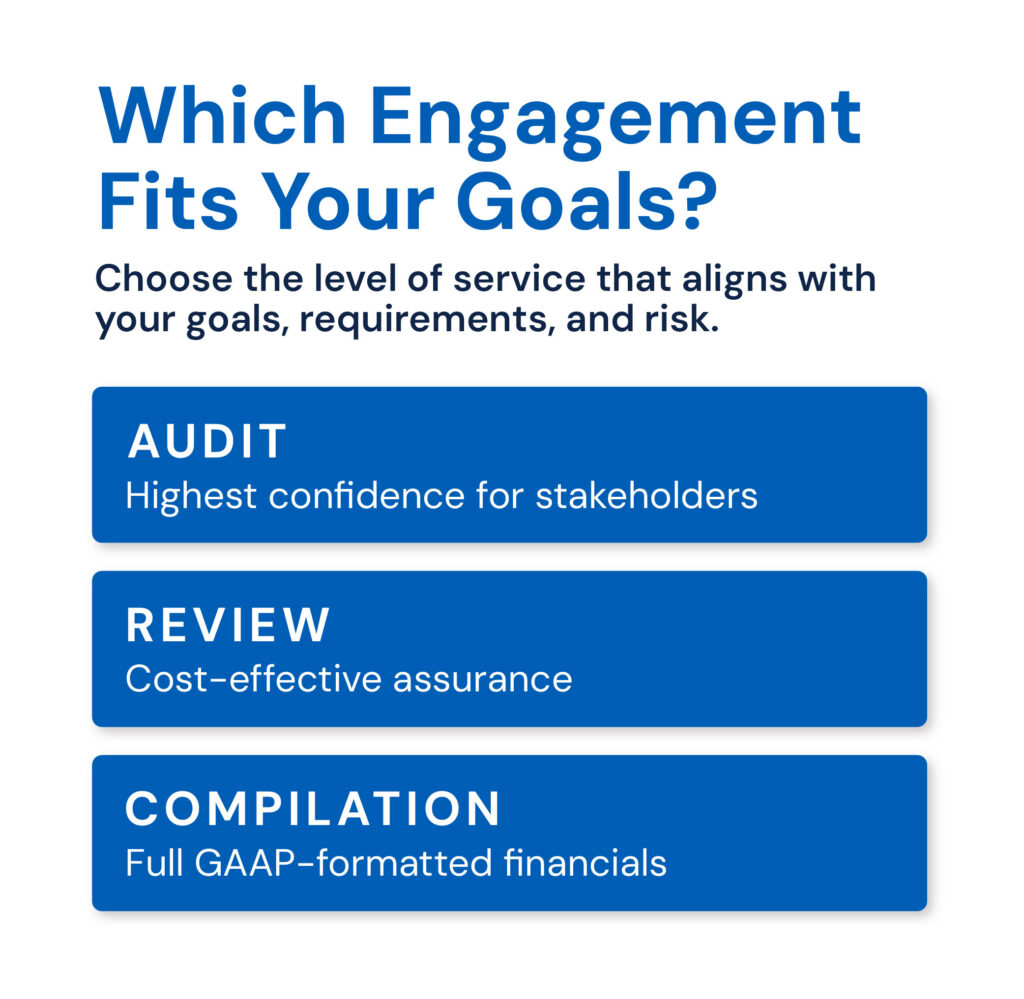
Selecting the right engagement comes down to considering your needs in terms of tiers. Here’s a simple way to think about it:
Still unsure? That’s completely normal. These decisions carry weight, and the right choice depends on your goals, stakeholders, and risk tolerance. The best way to gain clarity is by arranging a consultation with a CPA.
If you’re ready to clarify what your organization needs next, SSC is here to help you confidently move forward.

“SSC CPAs + Advisors” and “SSC” are the brand names under which SSC Advisors, Inc. and SSC CPAs, PA provide professional services. SSC Advisors, Inc. and SSC CPAs, PA practice as an alternative practice structure in accordance with the AICPA Code of Professional Conduct and applicable law, regulations, and professional standards. SSC CPAs, PA is a licensed independent CPA firm that provides attest services to its clients, and SSC Advisors, Inc. entities provide tax, advisory, and business consulting services to their clients. SSC Advisors, Inc. is not a licensed CPA firm. Our use of the terms “our firm” and “we” and “us” and terms of similar import, denote the alternative practice structure conducted by SSC Advisors, Inc. and SSC CPAs, PA. Advisory services provided through Merit Financial Group, LLC. Merit Financial Group, LLC is a registered investment advisor with the U.S. Securities and Exchange Commission.